https://www.data.jma.go.jp/multi/quake/quake_detail.html?eve...
https://www3.nhk.or.jp/nhkworld/en/news/weather-disaster/tsu...
https://earthquake.usgs.gov/earthquakes/map/?currentFeatureI...
https://www.tsunami.gov/?p=PHEB/2025/12/08/25342050/2/WEPA40
I live in Misawa (https://en.wikipedia.org/wiki/Misawa,_Aomori) and work in Rokkasho (https://en.wikipedia.org/wiki/Rokkasho), which is the area where the earthquake hit the strongest. It was quite violent, apparently the strongest earthquake ever recorded in the region. My house suffered no damage other than a few things falling off the cabinets, and I could sleep soundly afterwards, but lets see today at work.
Update: the tsunami warning has been lifted, in the end there was no major damage.
Was in a hotel in Sapporo, almost got thrown out of bed. Lot of people in the hotel lobby now.
Considering leaving Hokkaido by air if a Hokkaido and Sanriku Subsequent Earthquake Advisory is issued, don't really want to be in a potential megaquake.
People were freaking about the July megaquake prophecy and nothing happened. Trying to time it is silly, just chill and enjoy your stay, you'll probably be fine.
Megaquake is following a major earthquake is well documented. This is not silly prophercy stuff. Parent was talking about that case.
True, but when it not known. Worse, this may be the "megaquake". There are earthquakes all the time. There often isn't a megaquake following a big one. They do often enough to be documented, but not every time.
This is different than the July megaquake prophecy, which was indeed dumb. With a strong quake like this there will be aftershocks. Most will be small, but there is a risk (about 5% according to the USGS) of an even stronger quake than the first within the next week or so [1].
I agree the parent will likely be fine, but it can be stressful in the aftermath of a large quake. And if they want to leave the area and have the opportunity to do so calmly and safely, I think that’s justified.
[1] https://www.usgs.gov/faqs/what-probability-earthquake-a-fore...
Why was the July megaquake, an 8.8 magnitude, a dumb prophecy, but this "strong quake" at a magnitude of 7.6 is a smart prophecy?
This isn’t something that I personally wish to debate, but I’ll leave link to the wikipedia page for the July 2025 prophecy [1] for anyone who may not know what we are talking about.
And also point out that last night’s earthquake in Northern Japan was not a “prophecy”. Just a regular, large earthquake - which do occur pretty frequently in Japan. And I say "large" not just because of the magnitude, but because parts of Aomori experienced 6+ shaking on the shindo scale [2] which is categorized as "brutal" [3].
[1] https://en.wikipedia.org/wiki/July_2025_Japan_megaquake_prop...
[2] https://www.data.jma.go.jp/multi/quake/quake_detail.html?eve...
[3] https://en.wikipedia.org/wiki/Japan_Meteorological_Agency_se...
Source: it came to me in a manga.
Strange question.
The July megaquake prophecy scare was dumb because it originated in a work of fiction, not intended to be taken seriously by its author and not based on any scientific evidence. If the "prophecy" had come true, it'd be by luck alone. fwiw, I'd say it didn't come true; the 8.8 magnitude earthquake was near Kamchatka and didn't actually damage Japan, though a tsunami seemed plausible enough that there was a precautionary evacuation.
This "strong quake" is a thing that happened, not a "smart prophecy" [1]. Talk of aftershocks is not a prophecy either; it's a common-sense prediction consistent with observations from many previous earthquakes.
[1] smart prophecy is an oxymoron. A prediction is either based on scientific evidence (not a prophecy) or a (dumb) prophecy.
You are certainly reading something into my question that isn't there. I'm genuinely ignorant. I thought you were saying that predictions of a strong aftershock following an M8.8 were dumb, but the same thing following an M7.6 were smart. Is that not the case?
Again, sorry if this seemed antagonistic or something, I really am just unsure of what you were saying.
A manga book published in 1999 randomly predicted a disaster in March 2011, which seemed to come true with Fukushima. The manga was re-published in 2021 predicting a M8.8 in July 2025, but nothing happened. This is the dumb prophecy part, it was not based on seismology studies, just a shot in the dark to try to seem prophetic again. Countless works of fiction are published every year which predict some future disaster at an arbitrary date. Every once in a while, one of those thousands of random predictions can be interpreted as coming true when something bad happens on that day, which retroactively drives interest in that work of fiction, and less scientific minds believing the author has actual future predicting power beyond the abilities of science.
A relatively major (but not M8.8) quake has now hit in December 2025. It is intelligent to expect there may be aftershocks in the days after a significant earthquake actually happens, which can sometimes be larger than the initial quake. This is a well-accepted scientific fact born out of large amounts of data and statistical patterns, not whimsical doomsdayism.
Fukushima's M9.0-9.1 was around a 1-in-1000-year scale event. The last time Japan saw such a powerful earthquake was in the 869 AD. It would be reasonable to expect one of that scale to not happen again for another 1000 years.
Math nazi in me really wants to point out that an event with a 1:1000 probability would be expected to be seen (> 50% probability) in about 700 years, not 1000.
Heh, hence why I said 1-in-1000-year, rather than just 1-in-1000. Indeed 1:1000 would happen within 693 years with 50% probability, 1:1443 would happen within 1000 years with 50% probability.
Roughly how many Paul Erdős's to every Oswald Teichmüller though?
Great response and very informative - no clue how I totally missed the references and stories about this manga. That’s pretty cool - I’ll have to look it up!
You asked what I would have asked, in a sentence, my understanding is: it was LITERALLY a prophecy, I.e. an unscientific statement out of thin air, that in July, there would be an earthquake followed by a larger one. Here, we have reality, an earthquake, ergo the first prong of a mega quake was satisfied, as opposed to prophesied.
Ah, that's probably it. Thank you.
- [deleted]
That's a bit like comparing apples to oranges. One was published by social media, one was published by the Government of Japan.
I'm not a geologist, but this was pretty deep (44.1k) so not likely a foreshock right? Any actual geologists have a thought here? I know we have seen some indications that foreshocks can happen before megathrust earthquakes but it would need to be at the interface right? This looks like it is just the subducted slab deep down which in the 'intermediate zone' so not impacting the interface that 'slips' in a megathrust earthquake. (again, not a geologist) Now there have been, by that I mean just now, a 6.6 aftershock that was only 10km deep so that is potentially more concerning?
Good luck, the Sapporo Chitose airport is closed for inspection of both runways.
BTW, you are safer in hotel than outside. No need to stay in lobby, go to bed, just protect your head. I experienced much bigger one in Sapporo in 2018.
When I moved to SF, someone told me that the three most important things you can do for earthquake safety are:
- make sure nothing can fall on you when you're in bed (no mounted artwork above the headboard; no lamps etc on side tables that are high enough to fall on you)
- make sure you have footwear in your bedroom, so you can be mobile if there's broken glass everywhere
- store extra drinking water somewhere (I used a 6-gallon carboy that I periodically refilled)
Probably there are other good things to do, but all those made a lot of sense to me. Most of us spend more time in bed than in any other fixed location, so making sure the bed is a safe place rings true. And water is life.
Keep in mind that this is a major metropolitan area in a state that has a history of earthquakes. You can expect state level response (and federal as well) within the same day. Their main priority will be water, and elements exposure.
Guidance varies. California list here https://earthquake.ca.gov/wp-content/uploads/sites/8/2025/02...
You should have water, food, medical supplies, and cash.
btw you might find this interesting https://www.amusingplanet.com/2021/01/san-franciscos-hidden-...
Sf fire department has also a pdf with what you should have in an at home emergency kit. It's some simple things you can get in one trip to a camping store and Walgreens. https://sf-fire.org/media/794/download?inline
I also recommend SF people consider joining NERT: neighborhood emergency response team. Disaster after disaster should teach us the opposite of what you argue in terms of response: in fact it's more likely that the scale of people affected will quickly overwhelm resources, and the existence of choke points will severely limit movement of people and resources, especially if infrastructure is damaged and people are flooding out of the city. That can be mitigated by having locals trained to help facilitate emergency response efforts. It's less "pulling people out from under bookshelves" and more "help managing the bureaucracy of the fire department," forms on forms on forms! Though the training does involve pulling someone out from under a bookshelf. It's a week long and quite fun!
I’m curious, how is it more safer inside a building than being outside?
Modern buildings like hotels are built to withstand earthquakes of some magnitudes. Wouldn't count on that at a local construction site or a worn down house you might pass on the street.
Especially somewhere like Japan. A newer hotel is probably one of the safest places to be.
> worn down house you might pass on the street.
That "worn down house" might be good until "upper 6". Beyond that it all depends on when it was built and the associated construction standards at the time.
Source: https://isec-society.org/ISEC_PRESS/ASEA_SEC_03/pdf/St-5_v5_...
Buildings are built to resist earthquakes. Outside, anything (electric poles, roof tiles...) can fall on you.
Shards of glass falling from ten stories up would be one of the main things to try to avoid.
Sure, in the middle of a magnitude 9 earthquake I'd rather be in the middle of a suburban golf course (as long as it is far from any coastal tsunami) than any building, but I don't spend the majority of my time outside.
Two issues: 1. If you're making this choice during an earthquake, "outside" is often not a grassy field but rather the fall zone for debris from whatever building you're exiting. 2. If the earthquake is big/strong enough that you're in any real danger of building level issues, the shaking will be strong enough that if you try to run for the outside you're very likely to just fall and injure yourself.
Japan has had earthquakes forever. Their building regulations mandate things like isolation and dampers.
It all stems from an earthquake in 1923 in Yokohama which killed 140,000. Since then Japan's has over time developed some of the strictest seismic standards.
The main two ways people get injured in earthquakes (at least in Japan) are a) gas fires b) things falling on them. And being outside but near buildings is a good way for things to fall off those buildings onto you.
- [deleted]
Best of luck!
Official map with wave observations: https://www.jma.go.jp/bosai/map.html#5/33.909/141.192/&conte...
0.7m observed about 40 minutes ago.
This would be the tenth major earthquake (7+ magnitude) along the Pacific ring of fire this year.
With the Kamchatka and other earthquakes in the news recently I had a fear that were building to some major event but turns out that this year is about average if not slightly below average for major quakes along the ring of fire.
I heard that smaller (relative) earthquakes actually lower the prob of larger ones, so maybe it is a good thing? A bunch of 7.X earthquakes in the ocean are not going to be hugely destructive.
On the one hand earthquakes remove tension from the earth’s crust and release energy that can’t be used in future shocks.
On the other hand, if a shock doesn’t release all energy it may come to rest in a relatively weak spot that will soon give away again (https://en.wikipedia.org/wiki/Earthquake_swarm: “The Matsushiro swarm lasted from 1965 to 1967 and generated about 1 million earthquakes. This swarm had the peculiarity of being sited just under a seismological observatory installed in 1947 in a decommissioned military tunnel. It began in August 1965 with three earthquakes too weak to be felt, but three months later, a hundred earthquakes could be felt daily. On 17 April 1966, the observatory counted 6,780 earthquakes, with 585 of them having a magnitude great enough to be felt, which means that an earthquake could be felt, on average, every two and a half minutes.”)
Because of that, I think an earthquake will increase the probability of one occurring again soon, but decrease its strength.
> A bunch of 7.X earthquakes in the ocean are not going to be hugely destructive.
New Zealand’s 5th most deadly disaster was Christchurch’s 6.2 which killed 185 people. It was a shallow aftershock from a larger, less destructive quake.
The damage was huge.
The key phrase in the parent is “in the ocean”
Yeah, I didn’t miss that.
It’s a bit academic for a country like New Zealand where the sea is usually pretty close by.
Leading Sarah Wynn-Williams to decide Facebook was a great idea, to be able to contact people in an emergency, later got dissuaded, wrote a book https://www.amazon.com/Careless-People-Cautionary-Power-Idea...
Almost all energy released in earthquakes is released in the biggest ones. No realistic number of smaller quakes is ever going to add up to even the single biggest earthquake ever recorded.
To dissipate the energy of a M9 (which happens about once per decade) you'd need about 32,000 quakes of M6 (still big enough to collapse buildings).
Energy scales as 10^(1.5 × ΔM)
ΔM = 9.0 − 6.0 = 3.0
10^(1.5 × 3) = 10^4.5 ≈ 31,600
That's correct, if relatively small earthquakes would stop that could be the precursor to a much bigger one. It's like releasing tension gradually rather than all at once.
Isn’t that a myth? Do you have any sources to back up your claim?
Seems like it, & each rank is 30x more energy than the last[1]
https://www.usgs.gov/faqs/what-probability-earthquake-a-fore... Suggests 5% for larger quake to follow within week. But overall most sources I could find suggested it's hard to know, needs more research
1: https://www.reddit.com/r/askscience/comments/10wecl8/do_litt...
I think you intended this to be a validation of the idea that small quakes relieve stress and therefore lower the chance of a large quake.
The above link does not answer that question. It is relating stress release to "fault strength", or the maximum shear stress that can be withstood by the fault. There is an incidental relationship with depth that plays a role.
The video linked nearby (on criticality) also does not address the question at issue.
I'm only replying because I work adjacent to this area, and my understanding is that the idea that small EQ's release stress is a myth. Here [1] is another link, listed as #1 in the "Myths" category. And you can dig up quotes from none other than Lucy Jones [2] saying that this is a myth.
I don't work directly in this area, so I'm not willing to say absolutely no. But I'd really like to see a head-on reference supporting the claim that it's not a myth.
EQs are a release of energy. That energy is stored as stress prior to release. There is a finite amount of stored energy at any given time.
So the statement "EQs release stress" is true and it follows that adding the modifier "small" to the front doesn't change this.
It should also be immediately apparent that it would be very surprising if there were not statistical implications as a result of this. So surprising in fact that I would suggest that the burden of evidence should fall on those claiming that any such statistical effects are unexpected.
This part is unquestionably true. But since we don't have a direct measurement of the stored energy at a given time, the occurrence of an earthquake acts as both an indicator of release of stored energy but also, potentially, evidence of increasing stored energy.
Like how buying a Porsche costs money, and leaves you poorer than before you bought it, but when you see stranger buy a Porsche, you update towards believing that they're wealthy rather than poor.
Disclaimer: I am not a geoscientist.
Fair enough. I'm also not a geoscientist, and to clarify I didn't mean to imply any specific statistical effect there. It seems entirely reasonable to me that a series of EQs might tend to increase in intensity.
In reality I think (layman's impression) that there's rough (post hoc) evidence for both things. Foreshocks followed by noticably larger EQs as well as trains of progressively smaller EQs.
Precisely, and the 'myth' is worded in such a way that the effect of stress relieving pre-quakes is set to a big fat zero and that seems to be a thing more related to the composition of what is underground than the fact that it does not happen at all, and if it happens at what magnitude you would expect the effect to show up.
To me a myth is something that isn't true at all, not something that we do not have data on to be able to rule it out completely or that may be an influence just not a capital one. I think the most generous reading of the 'myth' claim would be that the energy available in the smaller quakes is too low to have a meaningful effect on releasing energy from a larger quake and I'll buy that. But at the same time an absence of such fore-shocks in an area where earthquakes are known to happen indicates that stress may be been building up over a longer time and that stress would be released in the next bigger quake if and when it happens.
This too may not be a big enough difference due to the immense increase in energy present in larger events (the scale is logarithmic). But its effect is quite probably still non-zero and for it to be a myth it would have to be zero.
Myth = the sun rotates around the earth
Myth = unicorns exist
Myth = the earth is 6000 years old
Those are directly falsifiable, and we know all of these to be categorical falsehoods.
Smaller earthquakes can - depending on local crust composition and other environmental factors - affect the amount of energy released in a larger one following, is not necessarily a significant effect (though even this would be tricky to establish) but I find it hard to believe they are completely unrelated though the effect may not be large.
Insignificant effect != Myth
For real: Earth science is complex. When you have domain experts literally saying the opposite of your guesses, in a section of an outreach webpage devoted to "Myths," reconsider your position.
(Related, and profound apologies for the fb.com link: https://www.facebook.com/DLJCSS/posts/small-quakes-do-not-pr...)
(Source: Work with Earth science domain experts in $dayjob, and am often surprised when my basic intuitive arguments turn out to be wrong.)
It wasn't a guess. It's a matter of definition.
Your link addresses a different claim than the one I made. So far we have release of stress (true by definition), statistical correlation (foreshocks and aftershocks), and reduction of a future event (your link).
As to objections about relative quantities, earthquake swarms exist. I think it's going to be just about impossible to make claims that are correct while also being applicable to all scenarios. A more limited claim that a particular quake or activity in a particular region does not exhibit a certain sort of relationship is going to be much more defensible.
https://news.caloes.ca.gov/earthquake-myths-separating-fact-...
Myth 5 is "Small Earthquakes Relieve Pressure and Prevent Larger Ones"
GP is correct; I'm not sure why CA gov is calling that a myth (it's not). However keep in mind that it's not necessarily true 100% of the time. Or at least the things it might seem to imply at first glance aren't true - the presence or absence of small quakes in a given period doesn't necessarily tell you anything useful about the future.
Indeed. But I get why people are confused because it is a subtle difference between 'stress relieved through small earthquakes is stress expended' vs 'stress relieved through small earth quakes is not indicative of the magnitude of future events'.
The long term absence of stress relief small quakes on a known fault line might be bad news, or no news at all, statistics are where the difference is here, not in particular events. See also, 'the big one' and various theories around it.
Myth: new knowledge never trumps old knowledge. Check the dates on those two publications.
This type of argument is kind of logical but not so immediately useful. Earthquakes just happen and no one is involved in that process. There could still be the big one coming, or that one might have been defused by this one. No one knows.
Various scientists in this video. The video is a great watch btw.
(stresses build up and are often released through many small, unfelt earthquakes (25:54). If these small movements don't dissipate the stress, it can accumulate and lead to a powerful chain reaction (26:25) * disclaimer I used YouTube's built-in AI to find/summarize the timestamps, as I couldn't remember offhand where it was when I previously watched this.
I don't believe the video quite says this (I watched the relevant section).
It's worth noting that they are mostly interested in critical phenomena in general, and earthquakes are kind of a drive-by application, treated along with fires and sand piles.
They do hint around the edges, but they don't head-on make the claim for earthquakes that small EQs materially lessen stress buildup and thereby make larger EQ's less likely.
I was looking for a credential of one of the people they interview, to see if they are really a solid earth person or more of a critical phenomena person -- their names aren't easy to find. This particular myth ("small earthquakes relieve stress") is a bit of a stinker in the solid earth community, and I think a solid earth person would be quite careful about their words as they discuss this.
I think you've summed it up correctly. It's not proof and some scientists claiming some things isn't the same as studies/evidence. However, is there evidence that it's not true? The fact is we do have these smaller movements and earthquakes quite regularly, so we don't really know what would happen after a long absence of them (do we? I suppose there are simulations perhaps that could be run? But I don't know that that's proof either way). To me though it makes a lot of sense that it would/could spur a huge event.
That is correct, but OTOH there was a 7.3 foreshock two days before the 2011 Tōhoku earthquake.
So the only thing we can say for sure is that it is still extremely difficult to predict earthquakes.
- [deleted]
The year isn’t over yet though … Jgov said there is a slightly higher chance of an 8+ in the next few days. Hope not.
It's probably related to a phenomenon we're not yet aware of.
It's probably not.
Like?
Alien invasion
Somewhat offtopic curiosity: Is there anything that Japanese fishkeepers do to keep the water and livestock inside the tank during earthquakes? Here we have no such risk for earthquakes, so a 600lb tank of water 4ft off the ground isn't much of an issue, even when bumped. I'd imagine earthquakes of this frequency could complicate that.
I have a 60L fish tank in my Tokyo apartment on around the 10th floor. It's sitting on stand that is not bolted to the wall. I have several friends with similar setups.
In the last 6 years there have been two or three earthquakes that caused enough water to slosh on to the floor.
Of those only the 2021 Fukushima earthquake caused any fish to slosh out - perhaps 10 medaka if I recall correctly. Luckily I was home and I was able to save all the fish, however there was one adult red cherry shrimp that didn't make it because I had trouble picking it up off the floor. I cleaned up the water with some paper towels and it didn't seem to cause any lasting damage.
I think if I had a 600 lb (270L?) tank or expensive fish though I would probably have a different perspective.
Does anyone else find the way of using tsunami.gov totally baffling? It tells the user almost nothing, and the target of all the hrefs for the supposed messages listed in the map is just the tsunami.gov homepage again. The entire above-the-fold is occupied by the map, and the map tells the user nothing.
The map has pins for events. At this moment there is one off Japan and one off Alaska.
anyone able to ping this to the lads at the National Design Studio?
https://www.tsunami.gov/?p=PHEB/2025/12/08/25342050/2/WEPA40
Shouldn't be too bad; USGS forecasts up to 1 meter tsunami.
Nhk has some more information - looks like the areas hardest hit will have been hit by now, with 3m high waves:
https://www3.nhk.or.jp/nhkworld/en/news/weather-disaster/tsu...
No, estimated height has nothing to do with actual measurements
Can you elaborate?
Yes. The Japan Meteorological agency has a piss poor machine learning model that basically defaults to predicting 3 meters wave every time there is an earthquake in the sea and in the end it's usually a few dozens of centimeters. They lost all credibility by crying wolf every single time.
1 meter is bad. That's a lot of water full of things you don't want slamming into you or any structure. Then it comes back full of even worse things.
Is 1 meter bad? In context it seems to be missing what kind of waves normally hit the coast line, and what kind tide differences exist, and what the current water level is when the wave hit.
What is a typical maximum wave height during hurricane seasons in north of japan?
Apparently 2 meters is : A 2 meters (6 ft 7 in) high tsunami hit Chiba Prefecture about 2+1⁄2 hours after the quake, causing heavy damage to cities such as Asahi. (Tohoku 2011) [1]
WRT comparison with hurricane waves, I assume they carry a lot less energy than tsunami's, because they are "superficial waves" - caused by the friction of the wind on the water - whereas a tsunami wave is caused by the movement of a huge mass of mater.
[1] https://en.wikipedia.org/wiki/2011_T%C5%8Dhoku_earthquake_an...
People vastly underestimate the danger of a moving body of water in general, but especially when that water is where it isn't normally. Even a relatively tame storm surge picks up sewage, dangerous chemicals, debris, and confused wild animals.
Today I got served this video "Earthquake and Liquefaction his Urayasu, Chiba 3/11/2011" [0], which is from the earthquake which caused the huge tsunami in Japan.
I have rarely seen something as scary as this.
The flood videos of towns, cars, and people being violently washed away are way scarier IMO.
Urayasu looks built on the water and all I see in the linked video is a threshold condition where the water is just barely peeking up through the ground below. People are still walking around, cars driving. There are far more chaotic and destructive scenes on youtube from that tsunami.
Different kinds of scary. The tsunami is clearly more dangerous as an actual threat, but it basically looks and works like a flood. This is a pretty familiar threat.
We think the ground is familiar too. So watching it change into something else, a squirming alien beast, is a different kind of fear. It violates your assumptions about what is safe, about what is possible at all.
I remember it, as it was unfolding live on tv. I've never seen anything as brutal as that tsunami, in terms of a natural catastrophe.
Terrifying. I know that Japan is earthquake-proofing its architecture but how about the underground infra? Do they have to dig and redo the pipes? The cables seem to be mostly overground (at least in this video) and are probably easier to repair (oldschool infra ftw).
> The cables seem to be mostly overground (at least in this video) and are probably easier to repair (oldschool infra ftw).
In Japan cables are (still) mostly overground. Use of underground is still a relatively new topic as addressed by the TEPCO website[1]. The first footer on the bottom of that page provides a nice TL;DR of the state of play:
[1] https://www.tepco.co.jp/en/hd/about/facilities/distribution-...The plans for underground conversion have consisted of "Plan for Underground Conversion of Power Lines", which covered three terms from FY 1986 to FY 1998, followed by the "New Plan for Underground Conversion of Power Lines" from FY 1999 to FY 2003, and then the "Plan for the Removal of Utility Poles" from FY 2004 to FY 2008. Based on these plans, approximately 7,700 km of lines all across Japan were placed underground over 23 years by the end of FY 2008 (with TEPCO responsible for approximately 3,500 km). Currently, we are consulting with related personnel regarding items such as locations for conversion as based on the new "Guidelines for the Removal of Utility Poles" established in FY 2009.
Oddly enough, the YouTube recommendation engine served that one up to me too.
Epicentre very deep underground, so shouldn’t be dangerous aside from small tsunamis.
Your comment prompted me to go read about epicenters and I learned something new. The hypocenter of an earthquake is apparently the point of origin of the earthquake and the epicenter is the point on the earth's surface directly above the hypocenter. Had never heard of a hypocenter before.
I didn't know about hypocenter before too but it's neat how you can sometimes deduce the meaning of a word from its parts (because "hypo" means "under"/"below" in Greek, like in hypodermic, hypoglycaemia, etc).
The class wasn't as interesting as I'd hoped, in part because it seemed to attract older kids hoping for an easy grade, but in my high school we had an etymology class.
(My school also offered Latin, but etymology seemed a much more direct/easier way to get the same basics. I just wish someone had taught me about demographics so I would have taken Spanish instead of German.)
But how much did they teach you about insects?
Basically every language works that way? You can say underquake in English if you like, doesn't have to be Greek. In fact, it might make sense to pick a widely understood language rather than one with ~13 million speakers
"Hypocenter", like "epicenter", is English, not Greek. These words, like many words in English today, are made of Greek components, which is why kids are taught in grade school English class about Latin and Greek roots.
No, not every language works this way, because not every language uses Latin and Greek root-words like this.
Ah yeah because everyone in England says hypo the sofa instead of under the sofa. Definitely not Greek
> not every language uses Latin and Greek root-words like this
I was responding to the text above where the person was amazed you can build/recognise a new word from parts. Idk who made the statement you're negating
Interestingly, I learned the word hypocenter in Japan as well, in a much more sobering way. The atom bomb that hit Hiroshima exploded above the ground, and the building directly under that, where the blast would have hit first, is called the hypocenter.
Gojira kimasu.
About 20 hours after the earthquake, the University of Tokyo sent out a follow-up advisory to faculty, students, and staff [1, scroll down for English]. This part hit home with me:
“The ‘follow-up earthquake advisory for the Hokkaido and Sanriku Coastal regions’ was established following the earthquake (M7.3) that occurred off the coast of Sanriku on March 9, 2011, two days prior to the Great East Japan Earthquake (Tōhoku Region Pacific Offshore Earthquake) that occurred on March 11, 2011.”
I was eating lunch in a fourth-floor restaurant in Nihonbashi, Tokyo, on March 9, 2011, when that preliminary tremor occurred. I had felt many earthquakes before, but that one seemed different: longer, slower, creepier. It didn’t cause any damage, but I often recalled it after the much bigger one struck two days later. (I missed the March 11 quake, as I happened to leave for Osaka just a few hours before it hit. My office back in Tokyo was damaged, though.)
[1] https://kankyoanzen.adm.u-tokyo.ac.jp/%e5%8c%97%e6%b5%b7%e9%...
NHK (english): https://www3.nhk.or.jp/nhkworld/en/news/20251209_02/
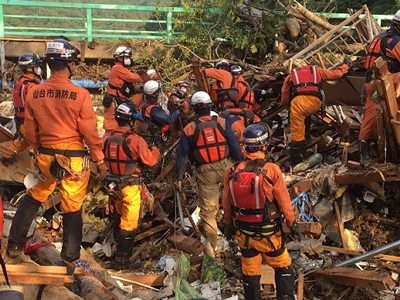
> The Japanese government set up a task force at the crisis management center in the prime minister's office at 11:16 p.m. on Monday in response to the earthquake.
A thousand Naruto shadow-clones just got deployed. I'm not being cute, these guys are heroes and role-models to all.
What's a Naruto shadow clone? Google hits are just about a kids show.
It is a kid's show. The main characters' outfit is modelled after Japan's iconic recovery workers (stark orange and blue), a compliment of their heroics echoed in fiction.
This character can clone himself hundreds times to help others, with art often mirroring the thousands of recovery workers seen in actual event footage.
My comment intended to link back the image of childhood heroes as corporeal selfless adults
It's a technique to temporarily make one or more duplicates of your body which can move independently and have your memories/abilities. A strong enough hit will dispel them, or the user can do it manually, after which the memories of what the clones did return to the user.
The usage here by GP might just be because everyone looks/is-dressed the same and is working in unison, and since they're Japanese, anime comes to mind. In the show, Naruto often uses shadow clones to pull off more complex techniques, throwing himself, having them take turns punching/kicking, or in the case of the rasengan he divides the work of controlling the ball of chakra since he struggled to do it successfully by himself.
That is the reference
The Wikipedia redirect is apparently dead (https://en.wikipedia.org/?title=Shadow_clone&redirect=no) and the main page for Naruto doesn't show anything about shadow clones.
Care to explain the reference? Do people dress up like a character from the TV show and help out people or what's going on?
The reference is that the anime character "Naruto"[0] wears the same colors and roughly the same uniform as a Japanese recovery worker[1].
During disaster work, you see swarms of recovery workers and the joke/reference being made is that this looks like Naruto doing a "shadow clone" technique.
[0] https://i.redd.it/psseu93j62la1.jpg [1] https://sendai-resilience.jp/media/images/efforts/case31_ima...
It took a while, but finally someone managed to get us confused westerners an answer! Thank you :)
It's an ability from the show: https://naruto.fandom.com/wiki/Shadow_Clone_Technique.
I’m imagining the folks from Shin Godzilla.
I assume that movie is for Japanese civil servants like the show Silicon Valley is for programmers. Stuff like the repeated meeting-room changes for no apparent reason reads as too specific and weird to be made-up.
(Thanks for the link - we've since merged the threads to a submission of that one. I've included the other major links that people have been posting in the toptext.)
When I was in japan the earthquakes were oddly exciting rather than scary, had three different ones while I was there that visibly shook rather heavy objects around. Two being in a building and one outside.
It was rather interesting seeing things shift around leaving a permanent imprint that there was in-fact an earthquake and it wasn't some kind of illusion when earthquakes these size couple of decades ago would cause non zero amount of damage.
Although, I am scared for tokyo about the predicted earthquake that would push all these systems near the breaking point and even beyond it, but hopefully the past in not prediction of the feature and instead it'll just be a lot of smaller earthquakes.
Funny, I had the exact opposite reaction. Things I had taken for granted all my life suddenly became un-anchored and as a result so did I. I have never felt an actual feeling of panic that threatened to overwhelm me before that happened and it was a very mild earthquake. I had to really force myself to calm down and stay rational and do what was the safest rather than to give in to the 'flee' reflex.
The problem with earthquakes is when they start you know you're in one but you have no idea where you're headed, whether this is as bad as it gets or whether you're going to end up in a pile of collapsed rubble and what is the best decision greatly hinges on something you can't know ahead of time, which is the peak magnitude and the kind of earthquake you are experiencing.
> Things I had taken for granted all my life suddenly became un-anchored and as a result so did I.
Same for me. If you don’t grow up with a number of small regular quakes or live in high-rise building that sways with the wind, it’s pretty unsettling to feel, what you always know as stable hard ground, solid buildings all of the sudden bouncing around. Rationally you know what it is and how it works but it’s still scary.
99% of your problem can be solved by studying statistics for your area, and having a plan... So that you aren't just at the whims of the moment when it's actually happening.
What kinds of statistics is it that one should study?
Having a bugout bag and emergency supplies and water on hand is a reasonable idea everyone with the means ought to do; it's a good thing to not have to depend on gov't intervention (not because of a lack of trust, but because the general public will, and the potential for mob situations is high).
But what should I have read about to know what to do? Topological maps and flood planes?
Op seemed to be freaked out about unknowns.
So my solution would be to look at historical data for earth quakes in his area so he knows basically what to expect.. that way when it starts shaking, he doesn't think "omg how big will this be?" And instead can know "ok this will be between 2.9 and 3.5 like the last 500 quakes in this area for 50+ years. Thank God no one has ever died in this area from an earthquake"
And then he can also know that he is prepared for even a much bigger quake in his area before... Because he prepared something.
This is obvious stuff. In case the guy I wrote to didn't know, now he does. If he wants to dwell in his neuroticism he can.
I always was in one of the major cities so I had full confidence in them. Lacking the natural fear of death probably has something to do with it as well.
What seems to matter greatly how affect someone is by an earthquake, seems to also be related to how used people are to being unbalanced. I was once with a group of friends who most of them were skaters and snowboarders, so used to thinking about balance and being in situations where they can't do much about it, standing on relatively unbalanced things. During the earthquake, similarly to parent, most of them were fascinated, while the non-skaters quickly panicked and threw themselves on the ground.
Of course, just an anecdote, and those people could also have a general lack of fear of death, but the difference between the two of you made me think of the event again.
I ski. Responding to being out of balance is just automatic, it doesn't come from needing to think about it.
It is a transferable skill. Have tried ice skating twice, could just do it fine.
Well you actually bring up a very good point, people who do extreme things know full well that one mistake and they can hit their head and never walk again, feeling the same fear while knowing that you are not in any danger is what creates excitement in a way.
I knew a woman like that.
I was secretly hoping for a 'proper' earthquake when I was living in Japan. Obviously I didn't want anybody to get hurt or anything to get damaged, but I only ever got to feel a few ~M3 earthquakes which were just slight bumps I felt when laying in bed.
I somehow ended up chasing major ones, had one shift my bed a quarter of a meter in saitama, then kyoto and finally a really strong one in osaka that shook the entire skyscraper pretty violently
- [deleted]
I lived in California for a while. I’ve always found earthquakes exciting. Probably because I trust the building codes and the ones I experienced were pretty mild.
(originally posted to https://news.ycombinator.com/item?id=46193413 but we've merged the threads)
I’m in Niseko (Hokkaido) and had just driven 2.5h through a snowstorm to my hotel, opened door, and put down bags and phone. Weird alarm from my phone (new phone; forgot to disable, which I usually do because where I live abuses the system for a bunch of stupid alerts for chronic issues), looked at it, realized in Japan it is probably real, so I stood in a doorway. Pretty decent sized storm.
If a tsunami affects me on a mountain something would be seriously wrong, so I’m not going to worry.
Do those alerts work for foreigners on data-only SIMs?
Yes. My partner got one in Morioka about 6 weeks ago.
Edit: very, very quickly after the quake, which we felt, I might add. I got a notification via the 'Safety tips' app long after. I think I was on Airplane mode at the time.
Unclear. I have a t-mobile e-sim in the phone I was using and that worked for me.
In case the site gets hugged to death:
https://www.tsunami.gov/events/PAAQ/2025/12/08/t6yfla/1/WEAK...
WEAK53 PAAQ 081430 TIBAK1
Tsunami Information Statement Number 1
NWS National Tsunami Warning Center Palmer AK
630 AM PST Mon Dec 8 2025
...THIS IS A TSUNAMI INFORMATION STATEMENT FOR ALASKA, BRITISH COLUMBIA, WASHINGTON, OREGON AND CALIFORNIA...
EVALUATION
----------
* There is no tsunami danger for the U.S. West Coast, British Columbia, or Alaska.
* Based on earthquake information and historic tsunami records, the earthquake is not expected to generate a tsunami.
* An earthquake has occurred with parameters listed below.
PRELIMINARY EARTHQUAKE PARAMETERS
---------------------------------
* The following parameters are based on a rapid preliminary assessment of the earthquake and changes may occur.
* Magnitude 7.6
* Origin Time 0515 AKST Dec 08 2025 0615 PST Dec 08 2025 1415 UTC Dec 08 2025
* Coordinates 41.0 North 142.3 East
* Depth 32 miles
* Location in the Hokkaido, Japan region
ADDITIONAL INFORMATION AND NEXT UPDATE
--------------------------------------
* Refer to the internet site tsunami.gov for more information.
* Pacific coastal regions outside California, Oregon, Washington, British Columbia, and Alaska should refer to the Pacific Tsunami Warning Center messages at tsunami.gov.
* This will be the only U.S. National Tsunami Warning Center message issued for this event unless additional information becomes available.
$$
(originally posted to https://news.ycombinator.com/item?id=46193413 but we've merged the threads)
USGS Tsunami warning circa. Dec. 2024
Seismic measurement, where weak or strong faults that are measured as seismometer, textual references to cartography, taking stock of tectonic plates.
[1]: https://news.ycombinator.com/item?id=42331326
[2]: https://web.archive.org/web/20250318161013/https://www.tsuna...
It has recently been a 4th degree one at Vitoria-Gasteiz, in the North of Spain. One of the least probable places you would even think of have an earthquake...
Unfortunately Spain and Portugal have seen quite a few earthquakes over the centuries, some of them quite deadly:
There may be a new subduction zone forming in the Atlantic off the coast there.
This all happens in geologic slow motion, of course.
https://www.livescience.com/37418-subduction-zone-forming-of...
That's the South; the zone I'm posting about it's pretty much near the Atlantic modulo a small mountain range.
The updated IGN website doesnt work properly for me. The old site was so much better, do you know if there is an alternative?
Did the title of the page change as only advisories are shown on the map. A warning is a very specific thing where the tsunami was seen and is coming.
GeologyHub video about this earthquake and "megaquake warning" that followed: https://www.youtube.com/watch?v=1POo07B2Iko
Does anyone has information if any prefecture got hit by big waves? If none, how much time usually before the warnings are lifted?
Any ram fabs in northern Japan?
Felt it in Tokyo. It was a quite solid shake, and lasted a minute or two.
Damn. That sounds bad. Hope it didn't trigger a tsunami.
I guess we'll know, soon.
- [deleted]
0.3-1m.
5.1 is major?
Is it so serious? It was extremely deep, normally that's not as strong, right?
[flagged]
We're seeing the buildup for a 9+ megathrust earthquake.
That's completely unsupported speculation.
How do you know?
If it happens today, OP is right, and if it happens in a century they are too.
What about if its in a millenium?
That's the nice thing about completely unsubstantiated, baseless claims on the Internet, if it ever happens, you can always point at it like you're Nostradamus.
My predictions:
Actual zombie president in 2044.
New COVID in 2061.
Dinosaurs come back in 2123, reveal they've been steadily populating hidden Nazi underground bunkers and have declared peace with the yeti.
- [deleted]
I've connected the dots.
To think that these are happening more and more around the world and the USA just lost 9 detection stations near Alaska because of NOAA budget cuts. There was also the giant tsunami in the middle of nowhere this year.
https://www.alaskasnewssource.com/2025/11/01/state-seismolog...
so don't talk about tsunami or how we are losing the ability to detect them in a tsunami post got it